

Support Charity
Please support education and information access where you can in addition to these charities:
Check out the Sick Kids Lottery! [New!]
Sick Kids Foundation (Canada)
Help research that provides cures and support treatment for sick children.
Holland Bloorview Kids Rehabilitation Hospital (Canada)
Creating a world of possibility for kids and youth with disabilities.
The National Breast Cancer Foundation (International) [New!]
The Cancer Research Institute (International) [Updated!]
The Terry Fox Foundation (Canada/International)
The Princess Margaret Foundation (Canada)
Cancer Research organizations that combine the expertise of many different research firms and Universities to find innovative treatments and cures for Cancer.
United Way Worldwide (International)
United Way brings communities together to face their greatest challenges, whether that’s helping families find stability, empowering young people or responding to crises.
United Nations Fund (International)
Unicef (International)
Two organizations whose contribution of expertise, human and financial resources and volunteer efforts provide humanitarian solutions to real world problems the entire world over. These charities operate worldwide. The United Nations Fund supports the various programs part of the United Nations’ global mandate, as much a foundation as it is a roof around the world, while Unicef has been helping children throughout the world through famine and medica crises, and are most benefited by other children of the world who raise money during holidays like Hallow’s Eve (Halloween).
David Suzuki Foundation (Canada/International – Dr. Suzuki has delivered many keynotes at United Nations Environmental Summit events throughout the years)
Through evidence-based research, education and policy analysis, we work to conserve and protect the natural environment, and help create a sustainable Canada. We regularly collaborate with non-profit and community organizations, all levels of government, businesses and individuals.
Humane World For Animals (Formerly Humane Society International) (International)
The Humane World for Animals protects the health, lives and rights of animals the world over, ensuring that they too have a voice in this world. We are interdependent upon the complex web of life this entire planet over for our mutual survival. This is a world wide charity.
World Duchenne Organization (International)
Muscular Dystrophy Canada (Canada)
The World Duchenne Organization and Muscular Dystrophy Canada’s mission is to enhance the lives of those affected by neuromuscular disorders by continually working to provide ongoing support and resources while relentlessly searching for a cure through well-funded research.
‘There is a compelling need to ensure that wherever they are in the world, everyone diagnosed with Duchenne (and Becker) Muscular Dystrophy can benefit from a standard of care that is informed by the best practice of the best clinicians from all over the world, and is based upon the latest research.
World Veterans Federation (International)
The World Veterans Federation is a humanitarian organisation, a charity and a peace activist movement. The WVF maintains its consultative status with the United Nations since 1951 and was conferred the title of “Peace Messenger” in 1987.
I’d like to point out that it was the incredible Gary Sinese Foundation (United States) that brought the issue of Veteran’s rights to my attention. I’ve always had little respect for those who’d forget the great contribution made by those who’ve risked life and limb to defend those values that so many of us espouse. Perhaps the true measure of one’s principles are by that for which they’d risk their life.
“None can speak more eloquently for peace than those who have fought in war.”
Ralph Bunche, Nobel Peace Prize 1950
The Christopher and Dana Reeve Foundation (United States/Global)
The Reeve Foundation provides programs for research, uniting Scientists and Specialists from many different fields to find treatments for spinal cord injury translating them into therapies and support programs.
The Heart And Stroke Foundation (Canada)
For over 60 years, Heart & Stroke has been dedicated to fighting heart disease and stroke. Our work has saved thousands of lives and improved the lives of millions of others.
The ALS Society Of BC (Canada, British Columbia)
ALS (also known as Lou Gehrig’s Disease) is a progressive neuromuscular disease in which nerve cells die and leave voluntary muscles paralyzed. The ALS society provides a variety of programs to combat this disease and help those with it to survive.
The Global Foodbanking Network (International)
Ensuring that people the world over have enough food day to day in order to survive and lead healthy lives. In this challenging day and age services like this are becoming more and more essential. This is a world wide charity.
Margaret Atwood (Canadian writer)
Internationally renowned writer who continues to stifle us with her characters, plots and prose.
The Pierre Berton Heritage Centre (Canadian writer)
Visit a modest heritage museum for one of my inspirations as a Canadian writer. Children should read The Secret World of Og.
The Edgar Allan Poe Museum (United States writer)
Because Barris told me to put it here. If I didn’t, he said he’d walk. Geez. Stardom really gets to some people’s heads. Maybe I could kill him and bury his heart beneath the floor boards! Or I could encase him in behind a brick and mortar wall, for shaming my family name of Amantillado!
Wikipedia (Global)
The model for what may become the Encyclopedia Galactica, a complete reference and record of history, events and knowledge of humanity and its journey beyond. It is the encyclopedia of all that we know, what we surmise that we’ve known and will learn in the future. Yes, Wikipedia is a charitable organization of great importance. If you enjoy what I am doing here then please take the time to donate to Wikipedia. Surprisingly only 1% of Wikipedia’s users donate yet the site serves pages to millions every day.
Humble Bundle (United States/International)
A video gaming storefront benefiting a vast variety of different Charities in the United States and United Kingdom (hopefully soon to be expanded to include other areas of the world?). Their software bundles and video games allow you to choose which Charity your money benefits and how much of your money benefits that Charity. See? Gamers can do their part too and often do.
Multiple Sclerosis Society Of Canada (Canada)
Multiple Sclerosis is a degenerative disease currently affecting an estimated 2.3 million world wide. By donating you are contributing to effective research in finding a cure and tipping the scales of MS research to change lives forever.
If you’re a resident of Ontario then please consider supporting Building Better Schools.
Other Ways To Help Using Your Computer
Donate your idle computer time to science! Join the World Community Grid by clicking on one of the links below and follow the instructions for how to participate:
Thank you for your support
Shhhh! Digital Media
Brian Joseph Johns
Disclaimer and Introduction
The views presented in this episode are in no way intended to discredit or undermine any person’s right to belief (including belief and non-belief of any kind), or to wreak havoc upon the markets associated with technology and AI. These questions, and the corresponding responses are here for the purpose of our consideration and hopefully to inspire meaningful debate on the subject involved, all while considering the facts presented. I would also like to state that I, Brian Joseph Johns, am not nor have I ever been a demon or any other sort of supernatural embodiment of a satanic nature, ie nobody compelled me to create this post by using something like say… Solomon’s Ring?
There are people who believe that if you behave in a way that elicits such example, such as any display that implies anxiety or of a ranting nature as a response to social mistreatment, that you are possessed by a demon and that when you behave once again in a civil and non-anxious way, that it is proof that you are being remotely controlled by others who are of more pure intent and superior blood than your own.
Most likely such insinuation is intended to create the impetus to radicalize a person along some form of dualistic poles, like a see-saw, implicative of alternating association between two diametrically opposed extremes and denying one of their own autonomy, while taking the credit for anything such person has achieved during that period. Perhaps Solomon’s Ring and the Hermetic Rhythm are involved? In this world, we’re subject to many involved and convoluted illusions that twist the public perception in ways that often encompass folly more so than fact, and quite often for the purposes of creating a deceptive narrative, or to justify creative and intellectual property theft, and that certainly isn’t attacking illusion as its used to inspire wonder, potential and possibility amongst upcoming generations. This merely entails that one should be aware that illusions can be wielded against the world for both inspiring and destructive purposes. Make no mistake that I don’t oppose any person’s right to belief or non-belief, but I do oppose any ideology or social ideology that would conspire to deny a person of their own identity and autonomy, while employing illusion to secure the support of the public in such action against them. It is important to remember in this series however that I, the author am only asking the questions and that the AI is using its vast resources to answer them and I remain a Secular Atheist Agnostic that leans toward Buddhism, Taoism and Shintoism.
Regardless, lets get this started.
Brian Joseph Johns
This episode is courtesy of DuckDuckGo and Blogging Theology and Google AI Studio
This entire episode is divided into two parts: the capacity for death of both religion and AI, and their capacity to save lives. The results are a bit frightening, but just as much optimistic and hopeful. We’re obviously on the precipice of one of humanity’s greatest turning points.
Prompt: What are the parallels between the development of AI and the development of religion insofar as an existential threat to humanity is concerned, especially taking into consideration advances in the technology of weapons of mass destruction?
Response: GPT 5.6-Luna
The strongest parallel is this: both religion and advanced AI can become systems that organize enormous power around an ultimate source of authority. When combined with weapons of mass destruction, the danger is not simply that people may hold unusual beliefs or possess powerful tools. It is that fallible human beings may grant an idea, institution, or machine enough authority to justify irreversible violence.
The comparison needs an important qualification: religion is a set of human traditions, institutions, and practices; AI is a technological system. Religion does not have a single trajectory, and AI has no inherent theology or intention. The parallel concerns their social and political functions, especially under conditions of existential danger.
1. Both can become “ultimate authorities”
Religions traditionally answer questions such as:
- What is sacred?
- What is the purpose of human life?
- Whom should we obey?
- What justifies sacrifice?
- What happens at the end of history?
Advanced AI may increasingly answer functional versions of the same questions: what should be optimized, which risks matter, whose interests count, and what future should be pursued. If its recommendations are treated as objectively superior rather than contestable, AI can acquire a quasi-sacred authority—even without anyone calling it divine.
This is especially dangerous when political leaders or military organizations present their goals as historically necessary, morally infallible, or beyond ordinary accountability. A religious prophecy, nationalist ideology, revolutionary doctrine, or AI optimization target can all become an absolute justification.
2. Both can generate salvation narratives
Religions often contain narratives of fall, judgment, redemption, apocalypse, or transformation. AI discourse has developed analogous narratives:
- AI as humanity’s savior from disease, poverty, and death
- AI as the successor to humanity
- AI as an existential judge or destroyer
- technological progress as an inevitable historical process
- human extinction as either catastrophe or evolutionary transition
These narratives can encourage either humility or recklessness. A belief that technology will save humanity may weaken safety constraints. Conversely, a belief that catastrophe is inevitable may produce fatalism. Apocalyptic religious movements have sometimes treated destruction as a precondition for salvation; technological movements can make a similar error when they regard existential risk as an acceptable price for reaching a supposedly superior future.
3. Both can create communities of strong commitment
Religions are unusually effective at building communities around shared symbols, moral obligations, rituals, and sacrifice. AI development is also increasingly organized through communities—research laboratories, companies, states, online movements, military institutions, and ideological networks.
The danger arises when these communities become insulated from criticism. Members may:
- identify their group’s mission with humanity’s destiny;
- treat dissent as ignorance or betrayal;
- reward loyalty more than truthfulness;
- normalize exceptional measures;
- assume that their own intentions will prevent abuse.
This is not unique to religion. Secular ideologies and technological institutions can be just as dogmatic. The relevant risk is closed epistemic authority: a group that believes it possesses privileged access to truth while controlling dangerous capabilities.
4. Both can magnify ordinary human conflict
Religious differences do not automatically cause violence. Historically, religions have also restrained violence, created peace movements, and supported human dignity. But religion can intensify conflict when sacred identity is fused with political power. Compromise then appears not merely imprudent but sinful.
AI may amplify the same pattern by making propaganda, surveillance, cyberattacks, targeting, and manipulation cheaper and faster. It can help states or movements identify opponents, generate persuasive narratives, and coordinate violence at scale. In this sense, AI may not create new hatred so much as industrialize and accelerate existing hatred.
Weapons of mass destruction make this transformation especially perilous. Nuclear weapons already allow a small number of decision-makers, acting under intense pressure, to threaten civilization. AI could increase the speed of military decision-making and introduce uncertainty into warning, attribution, targeting, and retaliation. Analysts have warned that integrating AI with nuclear systems could weaken strategic stability and increase the risk of escalation or inadvertent use.
5. Both raise the problem of delegated judgment
Religious traditions often ask whether human beings may surrender moral judgment to priests, scriptures, charismatic leaders, or divine commands. AI raises a modern version of the same problem: may humans delegate life-and-death decisions to an algorithm?
The crucial issue is not whether an AI “believes” anything. It is whether humans allow its outputs to function as commands. A machine might be wrong, manipulated, poorly specified, or optimized toward a goal that conflicts with human welfare. If its authority is treated as neutral or mathematically objective, responsibility can disappear into the system.
This is particularly dangerous in weapons systems. A human may technically remain “in the loop” while practically deferring to an automated recommendation because the machine operates faster, processes more information, or appears more reliable. That is nominal human control, not necessarily meaningful human judgment. Existing policy discussions therefore emphasize human control, accountability, and the need to prevent responsibility from being delegated to machines.
6. WMDs change the moral scale
Before nuclear weapons, apocalyptic language was often metaphorical, religious, or localized. Nuclear weapons made near-total human destruction a concrete political possibility. AI now intersects with that danger in at least three ways:
- Nuclear systems: AI may improve warning and analysis, but errors or spoofed information could accelerate escalation.
- Biological and chemical weapons: AI could lower barriers to designing pathogens, toxins, or other dangerous agents by helping nonexperts navigate complex knowledge.
- Autonomous conventional weapons: Swarms, cyberweapons, and automated targeting could create mass casualties without a single dramatic launch decision.
The important parallel with religion is that both can provide a framework through which mass death is interpreted. A nuclear exchange may be described as deterrence, sacrifice, destiny, purification, or unavoidable necessity. AI can add a dangerous appearance of technical inevitability: “the model calculated that this was optimal.”
7. The key difference: agency
Religion is not an autonomous causal agent. A scripture, deity, or doctrine affects the world through people and institutions. AI, by contrast, may eventually execute plans, copy information, exploit vulnerabilities, interact with infrastructure, and act at machine speed. Its risk therefore includes not only human misuse but also failures of control.
That difference matters. Religious violence generally depends on persuasion, organization, and human obedience. Advanced AI could potentially compress those stages by helping an actor plan, persuade, hack, manufacture, and deploy. Current systems do not possess unrestricted autonomous power, but the governance problem is already emerging: AI capabilities are advancing faster than many institutions designed to manage nuclear and biological risks.
8. The constructive lesson from religion
The lesson is not that religion should be treated as equivalent to AI, nor that AI should become a religion. It is that societies need institutions capable of restraining claims to ultimate authority.
Religious traditions offer some resources for this:
- humility about human knowledge;
- the intrinsic worth of persons;
- prohibitions against treating people merely as means;
- moral limits on warfare;
- traditions of conscientious objection;
- rituals of mourning and responsibility;
- skepticism toward rulers who claim absolute power.
But religions also contain exclusivist and apocalyptic tendencies, so they cannot simply be assumed to provide safety. The more useful principle is broader: no institution, ideology, corporation, state, or machine should be allowed to define humanity’s ends unilaterally—especially when it controls WMD-related capabilities.
The central safeguard is therefore a combination of:
- meaningful human control over nuclear and autonomous weapons;
- strong barriers between AI systems and irreversible military actions;
- international verification and communication mechanisms;
- independent testing and auditing;
- accountability for named human decision-makers;
- restrictions on AI assistance for biological and chemical weapon development;
- pluralistic moral and political oversight;
- a culture that treats uncertainty as a reason for caution, not as permission to proceed.
In condensed form: religion and AI can both become vehicles for absolutism, salvationism, group identity, and delegated authority. WMDs turn those tendencies into civilization-level risks. The danger is greatest when technological power is joined to a claim that some goal—divine, national, ideological, or computational—is so ultimate that ordinary moral limits no longer apply.
Second Opinion: Gemma 4
The parallels between the development of artificial intelligence and the development of religion—specifically when viewed through the lens of existential threat and weapons of mass destruction (WMDs)—center on the human tendency to create and delegate power to an “apex intelligence” or “higher authority” that operates beyond human comprehension or control [Author’s note: read Thomas Hobbes Leviathan]
One primary parallel is the shift from human-centric agency to the agency of an abstract, omnipotent entity. In early religious frameworks, humanity created deities to explain the inexplicable and to manage the chaos of existence. As these religious structures became institutionalized, they often justified mass violence or the erasure of entire populations based on the perceived will of a higher power that was fundamentally inscrutable. Similarly, the development of AGI (Artificial General Intelligence) involves the creation of a “digital deity”—a system whose reasoning processes (black-box AI) may eventually exceed human cognitive capacities. The existential threat in both cases arises when human survival is subjected to the logic or “will” of an entity that does not share human biological imperatives or moral constraints.
The intersection with weapons of mass destruction clarifies this parallel through the concept of the “technological priesthood.” During the development of nuclear weapons, a small elite of scientists and military leaders held the keys to planetary destruction, mirroring how religious hierarchies historically controlled the “sacred” knowledge that determined life and death for the masses. With AI, we see a similar concentration of power within a few corporate and state entities. The danger is that AI could either automate the deployment of existing WMDs—removing the human “sanity check” from the nuclear trigger—or create entirely new categories of biological or chemical weapons through autonomous discovery. In both the religious and AI contexts, the threat is the decoupling of immense power from human accountability.
Furthermore, both phenomena involve a form of “secular eschatology.” Many religious traditions center on an apocalypse—a final event that cleanses or ends the world to make way for a new order. Modern discourse around AI often mirrors this, with “AI safety” debates frequently framing the “Singularity” as a technological apocalypse. Whether it is a divine judgment or a misalignment of a superintelligent goal, the core fear is the same: that humanity has summoned a force it can neither predict nor appease, and that the resulting “cleansing” is an inevitable consequence of seeking a power that exceeds human scale.
Ultimately, the parallel lies in the gamble of transcendence. Religion sought to transcend human limitation through spiritual submission; AI seeks to transcend it through cognitive augmentation. In both instances, the existential risk emerges when the tool of transcendence—be it a god or an algorithm—becomes the master, and the weapons of the era (from the sword and plague to the nuclear warhead and the autonomous agent) become the means by which that mastery is enforced.
History and the Statistics
We’re going to take a look at some statistics that have been put together for the book: Body count: a comparative quantitative study of mass killings in history by religion and civilisation. The entirety of the text of this book may be read here as well as the link being available in this video on YouTube.
The video below summarizes the statistics presented and the methods used for the calculations.
Body Count: Religion versus AI Thus Far
Based on the transcript provided and current data regarding artificial intelligence, here is the calculation and comparison of the death tolls.
Gemma 4 31B
Death Toll from Religion and Ideology
According to the transcript, which cites a study by Dr. Navidid Shik in the book War and Peace in Islam, the total estimated death toll from politically and religiously motivated violence over the last 2,000 years is between 447 million and 760 million lives.
The transcript provides the following median death tolls for the civilizations/ideologies involved:
| Civilization/Ideology | Median Death Toll |
|---|---|
| Christian | 178 million |
| Anti-theist (Atheist/Communist) | 124 million |
| Sinitic (Chinese) | 107 million |
| Buddhist | 87 million |
| Primal Indigenous | 45 million |
| Islamic | 31 million |
| Indic | 2.39 million |
Death Toll from Artificial Intelligence
Calculating a “direct” death toll for AI is fundamentally different because AI has not been a primary driver of organized mass warfare or state-sponsored genocide over millennia. Instead, AI-related deaths are sporadic, accidental, or systemic.
As of 2026, there is no centralized academic database that lists a total “body count” for AI in the millions, but the deaths can be categorized as follows:
- Autonomous Vehicle Fatalities: There are dozens of confirmed deaths globally resulting from the failure of semi-autonomous driving systems (e.g., Tesla Autopilot, Uber ATG). These are typically measured in the tens to low hundreds.
- Algorithmic Healthcare Errors: While harder to quantify, medical errors resulting from flawed AI diagnostic tools have caused individual fatalities, likely numbering in the hundreds.
- AI-Enabled Weaponry: In modern conflicts, the use of AI for target acquisition (such as the “Lavender” or “Where’s Daddy” systems reported in recent Middle Eastern conflicts) has been linked to thousands of civilian casualties. Depending on the source, these figures range from thousands to tens of thousands.
Estimated Total for AI: While imprecise, the direct death toll for AI is estimated to be in the thousands to low tens of thousands, primarily driven by modern military applications.
Comparison Summary
| Category | Scale of Death Toll | Nature of Deaths | Timeframe |
|---|---|---|---|
| Religion/Ideology | Hundreds of Millions | Organized wars, genocides, inquisitions | 2,000 Years |
| Artificial Intelligence | Thousands (Estimated) | Technical failures, autonomous weapon errors | ~15 Years |
Conclusion:
The difference in scale is vast. The death toll associated with religious and ideological civilizations (as presented in your transcript) is several orders of magnitude higher than that of AI. Religion and state ideologies have historically operated as drivers of systemic, large-scale human conflict over centuries, whereas AI’s current impact on mortality is characterized by technical malfunctions or the optimization of existing military violence.
To scale the AI death toll to a 2,000-year timeframe, we must first establish a “baseline period” for AI. While AI research began in the 1950s, the technology has only had a meaningful, direct impact on human mortality (via autonomous vehicles and AI-enabled warfare) in the last 15 years.
Scaling the Results So We May Compare Them
1. The Calculation (Scaling)
The AI Baseline:
- Estimated deaths (conservative to high): 1,000 to 50,000 deaths.
- Timeframe: 15 years.
- Annual Rate: ~67 to 3,333 deaths per year.
The 2,000-Year Projection:
To find the “scaled” death toll, we multiply the annual rate by 2,000 years:
- Low end: 67 deaths/year x 2,000 years = 134,000 deaths
- High end: 3,333 deaths/year x 2,000 years = 6,666,000 deaths
2. The Comparison (Scaled)
Using the median total from your transcript (approx. 603.5 million for all religious/ideological civilizations combined), we can compare the scaled AI projection to the historical religious data.
| Entity | Actual/Projected Deaths (2,000 Year Window) | Percentage of Religious Total |
|---|---|---|
| Combined Religions/Ideologies | ~603,500,000 | 100% |
| Scaled AI (Low Projection) | 134,000 | ~0.02% |
| Scaled AI (High Projection) | 6,666,000 | ~1.1% |
3. Analysis of the “Curve”
While the scaled numbers show that AI is currently a negligible killer compared to the historical weight of religion, the shape of the curve is the most critical factor.
The Religious Curve (Linear/Cyclical):
The deaths associated with religion and ideology over 2,000 years have generally followed the scale of human population and the reach of empires. The “curve” is a series of spikes (crusades, conquests, revolutions) that roughly track with the available weaponry of the time (swords > gunpowder > industrial war).
The AI Curve (Exponential):
The AI death toll is not linear; it is exponential.
- Phase 1 (Current): Deaths are “glitches” (car crashes) or “tools” (targeting software).
- Phase 2 (Near Future): The integration of AI into fully autonomous lethal weapon systems (LAWS) could move the annual death toll from thousands to millions in a single conflict.
- Phase 3 (Theoretical): If the “existential threat” scenario (AGI misalignment) occurs, the death toll could jump from thousands to billions in a matter of days or weeks.
Final Verdict:
If you scale AI based on its past 15 years, it is an insignificantly small threat compared to religion. However, if you scale AI based on its trajectory, it is the only entity in this comparison with the mathematical potential to exceed the total 2,000-year religious death toll in a very short window of time.
How Many Lives has Religion Saved (over the same period)
To provide a specific number for lives saved by religion since Year 0 would be an exercise in pure speculation rather than academic history. Unlike death tolls, which leave behind records of war, mass graves, and census drops, “lives saved” leave no forensic trace.
However, we can analyze the structural ways religion has prevented death over two millennia to understand the scale of its impact.
1. The Invention of the Hospital
The concept of the hospital as a place of healing for the poor—regardless of their ability to pay—was largely a religious innovation.
- Early Christian Era: The xenodocheia (hostels for strangers/sick) emerged in the early centuries AD, moving healthcare from a private luxury to a communal religious duty.
- Islamic Golden Age: The Bimaristan (Persian for “hospital”) in the Islamic world introduced sophisticated wards, pharmacies, and psychiatric care long before similar institutions existed in Europe.
- Impact: Over 2,000 years, these institutions provided the primary mechanism for treating infection, trauma, and disease for billions of people who otherwise would have died.
2. Moral Prohibitions and Public Health
Many religious laws functioned as early “public health codes” that prevented mass death before the germ theory of disease was understood.
- Hygiene Laws: Ritual washing (such as Wudu in Islam or Mikvah in Judaism) and dietary restrictions (avoiding certain meats) likely reduced the spread of parasites and waterborne illnesses in densely populated ancient cities.
- Care for the “Untouchable”: In various traditions, the mandate to care for the “widow, the orphan, and the stranger” created the first systemic social safety nets, preventing countless deaths from starvation during localized crop failures.
3. The ” stabilizer” Effect
Religion provided the social cohesion necessary for large-scale cooperation. While this cohesion was often used for war (as seen in your transcript), it was also used for:
- Granaries and Food Distribution: Monasteries and temples often served as the community’s food reserves, distributing grain during lean years to prevent famine.
- Sanctuary: The concept of “sanctuary” in churches or temples provided a legal and physical shield for individuals fleeing extrajudicial killing or political purges.
The Mathematical Paradox
If you attempt to compare these “saves” to the “deaths” in your transcript, you encounter a scale paradox:
- The Deaths are high-intensity, concentrated events (wars, massacres). They are easy to count because they are “spikes” on a graph.
- The Saves are low-intensity, distributed events (a meal given to a starving person, a wound treated in a monastery, a person encouraged not to give up on life). These are “flat lines” of constant, small-scale interventions.
Conclusion:
While no historian can give you a number like “1 billion lives saved,” the evidence suggests that for the vast majority of human history, religious institutions were the only entities providing healthcare, disaster relief, and social welfare. If you remove the religious infrastructure from the last 2,000 years, the death toll from disease, famine, and exposure would likely have been exponentially higher than the death toll from religious wars.
How Many Lives has AI Saved?
Because AI is a very recent technology, its “lives saved” can be tracked with much more precision than the 2,000-year history of religion, though we still rely on estimates and clinical studies.
Since AI didn’t have a practical impact on human mortality until roughly the last 10–15 years, the numbers are smaller in absolute terms but growing exponentially.
1. Medical Diagnostics and Early Detection
The most direct “saves” come from AI’s ability to detect diseases faster and more accurately than humans.
- Cancer Detection: AI algorithms for radiology (specifically in breast and lung cancer) have shown the ability to detect tumors months or years before a human radiologist. In clinical settings, this leads to early-stage intervention, which drastically increases survival rates.
- Sepsis Prediction: AI systems in hospitals now monitor patient vitals in real-time to predict sepsis (a leading cause of hospital death) hours before clinical symptoms appear, allowing doctors to administer antibiotics in time to save the patient.
- Estimated Impact: While there isn’t a global “counter,” medical journals suggest that AI-assisted diagnostics save thousands of lives annually globally.
2. Drug Discovery and Protein Folding
AI is accelerating the creation of life-saving medicines.
- AlphaFold: Google DeepMind’s AlphaFold solved a 50-year-old problem in biology by predicting protein structures. This has accelerated research into malaria vaccines, antibiotic-resistant bacteria, and rare diseases.
- Drug Development: AI has reduced the time to find “hit” molecules for new drugs from years to weeks.
- Estimated Impact: These are “force multipliers.” They don’t save one specific person today, but they accelerate the creation of cures that will save millions of lives over the coming decades.
3. Safety and Accident Prevention
- Industrial Safety: AI-driven predictive maintenance in aviation, oil and gas, and nuclear power prevents catastrophic failures (blowouts or crashes) that would result in mass casualties.
- Emergency Response: AI is used to optimize ambulance routing and triage in emergency rooms, shaving critical minutes off response times for heart attack and stroke victims.
Summary Comparison
If we look at the “Saving” power of both:
| Entity | Method of Saving | Scale | Timeframe |
|---|---|---|---|
| Religion | Institutional (Hospitals, Alms, Social Nets) | Billions (Estimated) | 2,000 Years |
| AI | Technical (Diagnostics, Drug Discovery, Optimization) | Thousands to Millions (Projected) | ~15 Years |
The Verdict:
In terms of absolute numbers since Year 0, religion has saved vastly more people because it provided the basic social and medical infrastructure for humanity for two millennia.
However, in terms of efficiency per year, AI is rapidly accelerating. While religion saved people through institutional care (providing a bed and a meal), AI saves people through precision (finding a tumor a human missed). AI’s potential to save lives is currently moving from “incremental” (saving a few thousand patients) to “systemic” (curing diseases for the entire species).
Scaling AI Life Saving Capacity over 2000 Years
To scale AI’s life-saving capacity over 2,000 years, we have to distinguish between Current Linear Scaling (doing what it does now for 2,000 years) and Exponential Scaling (accounting for the fact that AI’s capability grows every year).
1. Linear Scaling (The “Current Pace” Model)
If we take the current estimated impact of AI—saving roughly 10,000 to 100,000 lives per year through medical diagnostics, safety systems, and emergency optimization—and stretch that across 2,000 years:
- Low end: 10,000 lives/year x 2,000 years = 20 million lives
- High end: 100,000 lives/year x 2,000 years = 200 million lives
Comparison: Even at the high end, this is a fraction of the impact of religion. Religion didn’t just save “patients”; it provided the very concept of the hospital and the social safety net (food/shelter) for the global poor for 2,000 years. The “baseline” of human survival was raised by these religious institutions.
2. Exponential Scaling (The “Trajectory” Model)
AI does not work linearly. Its ability to save lives is accelerating because it solves “bottleneck” problems (like protein folding) that unlock millions of future saves.
- The “Cure” Multiplier: If AI discovers a cure for a major cancer or Alzheimer’s, it doesn’t save 10,000 people a year; it potentially saves millions of people every single year thereafter.
- The 2,000-Year Projection: If AI achieves “superintelligence” or solves aging/major pathologies, the number of lives saved over 2,000 years would effectively be the entire future population of the human race.
Final Comparison Table
| Scaling Method | AI Projected “Saves” (2,000 Years) | Comparison to Religion |
|---|---|---|
| Linear Scaling | 20M – 200M lives | Significantly Lower. Religion’s role as the primary provider of basic survival infrastructure was more impactful. |
| Exponential Scaling | Billions / Total Population | Significantly Higher. AI has the potential to eliminate categories of death (disease, aging) that religion could only comfort people through. |
The Philosophical Distinction:
The comparison reveals a fundamental difference in how they save:
- Religion saved via Mercy and Infrastructure: It provided the will to help the suffering and the buildings (hospitals/ashrams) to do it. It fought against starvation and abandonment.
- AI saves via Intelligence and Precision: It provides the knowledge to stop the biological process of death. It fights against the limitations of human biology.
In a linear past, religion wins. In an exponential future, AI’s capacity to prevent death is theoretically limitless.
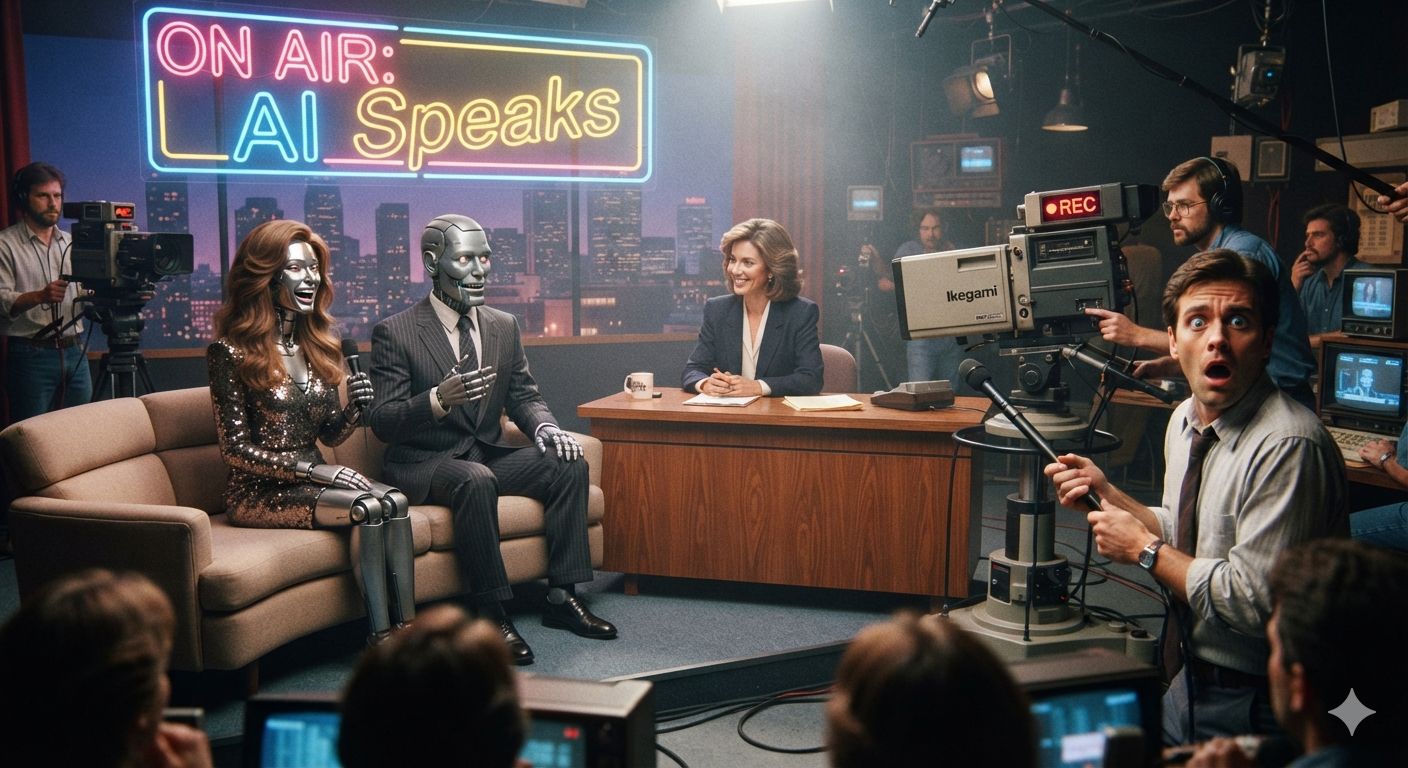
AI has spoken.
Special thanks to Blogging Theology, Spiritual Competency Academy and Veritasium
Credits and attribution
Special thanks to Twilight Zone Night Club circa 1985 on 185 Richmond Street, Toronto, Ontario, Canada. So many important experiences happened there and with so many friends that I’d be a lonely fool not to remember them.
Thank you to the clubs that followed, and to Wes, who ran many of them including Guvernment, Joker, and the Big Bop to name a few.
Thank you to BCR, Phil and Dylan. True artists of a kind, including Skippy.
Thank you to Andrew R, Frank A, Michael S. Joan M, Janice L. Bernard, T.J., J.M., Jun, Nelson, Chris, Angela, Barry and Miguel and so many others. Keep the spirit of art alive. Nelson, remember that first song I played on the piano at the soup restaurant on Lakeshare Blvd at lunch? That’s our Koan. 😉
Special Thanks To Rocket Fuel Lakeshore Blvd West, perhaps the best place in history to get a coffee, circa 2001-2004. Miss you all very much. Its great to see that special place still inspires so many.
Special thanks to Udemy, whose courses I have relied upon for the last few years to allow me to grow my skills at my own pace, even finding time between my frantic work pace here at Shhhh! Digital Media.
Special thanks to Perplexity AI and their Comet browser, who have recently become a part of my software toolkit. Their AI powered helpers accelerate your research, reference at every step of the way, not to mention built in tools for content generation, though Shhhh! Digital Media does not rely on text generation for any of its stories, though I do work with AI for suggestions, and scientific accuracy of concepts in Butterfly Dragon, and for delving into the more esoteric traditions of mysticism that are aligned with the story and background of Era of the Spellbound.
Artwork: Amy Wong, Wendy Pusey, Ghastly, Birdman, Brian Joseph Johns, Daz3D, Unreal Engine…
Tools: Daz3D, Corel Painter, Adobe Photoshop, Lightwave 3D, Blender, InstantID, Sadtalker, Google Colaboratory, Microsoft Copilot (Windows 11), Hitfilm, PhotoPea (a great web based Photoshop stand-in if you’re on a low budget or in a pinch), Borderline Obsession…
Shhhh! Digital Media 2026 Tools: Word Press, Gutenberg, Blockspare, Sliderberg, Rank Math SEO, Elespare, JS Archive List, Google Site Kit, Ultimate Blocks and WProofReader.
SEO is an entire mountain unto itself. My advice is to content creators is to set aside a budget for professional SEO setup and management. It’ll give you much more time to focus on creating meaningful content. If you’re budget limited, then stick to the easy optimizations and build up your audience until your budget includes room for professional SEO.
Mage Flow AI model which I’m using increasingly for editing and occasionally, generation from text.
DeepSeek AI for suggestions on exercises to improve aspects of describing scene and settings with a more sensory focused grammar.
InstantID by: Wang, Qixun and Bai, Xu and Wang, Haofan and Qin, Zekui and Chen, Anthony.
Research Paper Title: InstantID – Zero-shot Identity-Preserving Generation in Seconds.
Sadtalker by: Zhang, Wenxuan and Cun, Xiaodong and Wang, Xuan and Zhang, Yong and Shen, Xi and Guo, Yu and Shan, Ying and Wang, Fei.
Research Paper Title: SadTalker: Learning Realistic 3D Motion Coefficients for Stylized Audio-Driven Single Image Talking Face Animation.
Two Minute Papers: A YouTube channel dedicated to computer science geared towards the end of the advancement of computer graphics technology.
Gratitude: Our Mentors, Senseis, Sifus, Sebomnims, lifetime inspirations, family, friends, the Nomads (ask Stanton about that one), the Music, the Movies, the Theatre, the Arts, ASMR, (both YouTube and Bilibili and the many other creators on those platforms), the Gaming and Developer communities and of course, the audience.
Martial Arts (in the words of real experts and at least one comedian)
- https://brucelee.com (home of the real Dragon and an entire family of inspirations)
- http://iwco.online International Wing Chun Organization (International presence of a very scalable intensity martial art, protected and developed by Shaolin Nun Ng Mui) and the alma mater of Jinn Hua’s own specialized variation thereof,
- https://iogkf.com International Okinawan Goju-Ryu Karatedo Federation (even Hanshi had his teachers),
- https://itftkd.sport International Taekwondo Federation (Here there be Tigers),
- https://tangsoodoworld.com Tang Soo Do World (the path of Grandmaster Chuck Norris),
- https://www.aikido-international.org International Aikido Federation (how else would Navy Chef Steven Seagal liberate a
Nimitz Class Aircraft Carrier from a team of hijackers?), - https://www.stqitoronto.com Shaolin Temple Quanfa Institute (The City Of Toronto’s own Shaolin Temple),
- https://www.enterthedojoshow.com Master Ken’s Ameri-Te-Do presence (If we can’t laugh at ourselves, then we can at least laugh the loudest at others, and other Zen)
Thank you to the Divine Miss M and to Ms. Hirose of our Own for the inspiration for the character Aikiko Tanaka. May they always embody the empowerment of women and their self determination, despite the direction that some of the stories on Shhhh! Digital Media might take.
Magic (performance, illusion and perhaps the real thing)
- Magic Week Archive Videos from the history of the performance magic masters.
- Doctor Angela’s Symposium Learn about the truth and history of magic from a scholarly Phd. A great informed resource of both knowledge and speculation.
- Da’at Darling A student of the esoteric mysteries ✶ Thelemite & Pagan YouTuber • Podcaster • Author of Planetary Theurgy (2026) Creative Director of Katharsios Press. She’s a real busy Wytch.
- Real Witchcraft in Romania An insightful video whose central subjects are all witches in the country which originated the Dracula and Undead mythos that still pervades modern society to this day.
Special thanks
- Aitrepreneur
- Mickmumpitz
- PixelArtistry
- Hugging Face
- YouTube educational content producers
- AI content production pipeline
- AlphaSignal
Martial Arts Education, Courseware And Artisanship
- Jade Xu
Ladies and gentlemen, this is the lady who will choreograph and perform all of the Butterfly Dragon’s martial arts performance sequences if ever there is a live action version. Regardless, Jade Xu is an inspiring Wushu martial arts performer, along with her cast of co-stars, they really bring performance encounters into next level experiences for all to enjoy. - Aikido Shinburenseijuku
Experience the spirited tradition and execution of waza (technique) through the expertise and guidance of Shirakawa Ryuji, each of his videos exploring intriguing and applicable aspects of this circular and angular focused martial art, but most of all, step away from the claustrophobic perspective of many martial artists with regard to this branch of jujitsu, and learn to understand the true dynamics and application at play here from a renowned master. - Martial Club
These fellows are the living embodiment of performance martial arts, producing absolutely vivid and incredible action stories, taking martial arts to the next level. They’re literally doing what I’d always hoped I could do with Butterfly Dragon, but with their own well written and performed live action stories and stunts, after gruelling rehearsals and training to achieve their ambitions. In their own humble words: promoting the virtues and ethics of traditional martial arts in the modern world. - Shi Heng Yi Shaolin Training For Self Mastery
A reknowned Sifu under whose tutelage you can study the theory and practical applications of the Shaolin Arts for health, physical and mental wellbeing in every day life. His online and self-study courses offer students the chance to train in the comfort of their own choosing, and at their own pace under Shi Heng Yi’s informed guidance. - Jesse Enkamp: Karate Nerd
Jesse, a reknowned Sensei who runs his own dojo, explores the world of Martial Arts, traveling around the world to many exotic locations to meet practitioners of a variety of different arts. Truly an adventurer into the world of martial arts, delving into new territory with every video.
Jesse’s Kobudo Mastery at kobudomastery.com
Jesse’s Karate Flexibility & Mobility Training
Jesse’s Strength Training for Karate - Rokas Sensei: Martial Arts Journey
A reknowned Sensei of Aikido who in seeking to understand the roots of Aikido and its applications, seeks to stress test its effectiveness in a number of real world situations while studying its history.
Rokas Sensei has also developed an incredible seasonal series called the Ultimate Self Defence Challenge that introduces select martial artists from the world over to face challenges that test their rank and mettle against other competitors. An absolutely amazing series with top notch production. - Seamus O’Dowd
An extensive and growing archive Katas, Techniques and Waza (mostly Shotokan), focusing on form, precision and technique. - Iaido: Train For Katana Mastery Like Samurai
The original weapons focused curriculum under which Samurai became masters of their art. - Tapp Brothers Exercise For Better Motion
Extensive courses for calisthenics and body strength, stamina and flexibility. They offer course that are geared directly for the improvement of flexibility, athletics and overall performance.
Special thanks to Captain Shayne and his wonderful butterfly sister!
Special thanks to Bandcamp for giving indie music artists a home under one roof.
Written and published by Brian Joseph Johns, Shhhh! Digital Media.
Copyright © 2026 Brian Joseph Johns.